From Factory Floor to Flexible Workshop: A Short History of Asian Manufacturing
Asian manufacturing history is easier to understand when you can see how workshops, plants, and export networks changed workers’ tasks and control.
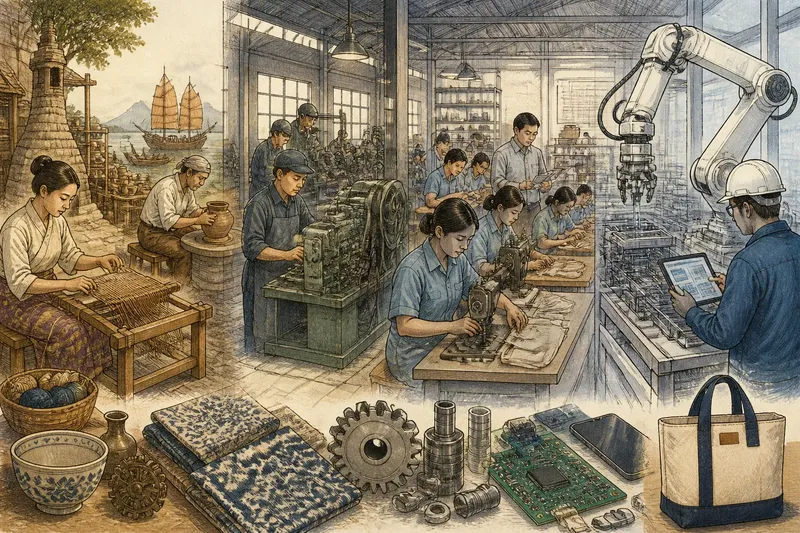
The common mistake in reading Asian manufacturing history is to treat “the factory” as one machine that simply got faster. That shortcut hides what changed for workers: who set the pace, who held the skills, and where decisions were made. It also turns a varied history into a tidy march from hand tools to robots, a map that shows only highways.
Asian manufacturing history makes more sense as a set of changing arrangements: household production, industrial plants, export networks, and workplaces that combine people with digital tools. These forms have overlapped rather than replacing one another in a single sequence. The examples below stay specific because the region’s differences matter as much as its shared shifts.
Household work kept production close to home and tied to buyers
In parts of Japan, India, and China, household and small-workshop production has included activities such as weaving, ceramics, metalwork, and food processing. These are not interchangeable arrangements. A household loom, a village kiln, and a town metal shop depend on different materials, skills, buyers, and local histories.
Working at home could give producers control over some tasks and schedules, but it did not make them independent of markets. A merchant might supply materials, set quality requirements, and collect finished goods, while producers carried uncertainty about whether the next order would arrive. Household labor could also mix paid production with farming and domestic responsibilities. A workshop could be close to home without being free of pressure.
As larger plants expanded, smaller producers did not necessarily disappear. They could serve local customers, make specialized goods, or supply parts and finishing work to bigger firms. The useful question is not whether a place was “traditional” or “modern,” but how production was divided between different kinds of workplaces and who controlled their links.
Factories concentrated machinery, supervision, and production decisions
Mechanized factories brought workers, equipment, and supervision together in purpose-built plants. Power-driven machinery could support larger or more regular output, but its effects depended on the product, investment, and labor system. A textile mill, a steel plant, and a small-goods assembly shop reorganized work in different ways.
Within a large plant, tasks could be divided into narrower operations. Managers and technicians planned schedules; machine operators maintained a steady process; inspectors checked output against requirements. Some craft knowledge moved into equipment, drawings, or supervisors’ instructions. Other skills—especially setup, repair, and coordination—could become more important. Machinery changed where knowledge sat and who was authorized to use it; it did not simply erase skill.
There is no single regional timetable behind these changes. Japan’s industrial development, for example, differed from India’s and China’s in its institutions, markets, and historical conditions. Across Asia, colonial rule, state investment, private enterprise, access to ports, domestic demand, and labor arrangements shaped what factories made and how they operated. Those differences make comparison useful, but a single sequence misleading.
Export networks linked factory floors to distant buyers
When factories made goods for overseas markets, local production became more dependent on orders, shipping, and purchasing decisions made elsewhere. Export-oriented manufacturing connected some communities to new machinery and industrial work. It also made factory schedules sensitive to changing product lines and delivery demands.
A plant might produce a complete item, or handle just one stage, such as cutting fabric, assembling components, or finishing electronics. Specialization can let firms focus on particular tasks, but workers may be left with repetitive operations while design, branding, and buyer relationships remain elsewhere. The factory is part of a larger network, even when workers have little say over its terms.
Say a fictional workshop in Vietnam makes canvas bags for an overseas retailer. Its starting point is a fixed row of sewing stations, with each worker assigned one operation and materials sometimes waiting between stations. After orders begin to include several bag designs, the owner groups workers into small teams, trains each person on multiple operations, and has a supervisor track materials and deadlines. The expected observable result is fewer idle gaps between tasks and more coordination within each team. The tradeoff is that workers take on broader responsibilities; whether that improves the job depends on how training time, pay, and workload are handled.
Flexible production can move pressure down the supply chain
Some manufacturing systems emphasize shorter runs, changing product ranges, and closer coordination among suppliers. Digital scheduling, computer-controlled equipment, and faster communication can make it easier to adjust certain operations. But flexibility is not one technology, and it does not automatically give workers more choice.
A plant can become more adaptable by cross-training employees and giving teams authority to manage several stages. It can also do so through temporary labor, subcontracting, or suppliers that absorb sudden changes. In the first arrangement, broader skills may come with more control if workers receive time and authority to learn. In the second, uncertainty may shift down the chain, leaving workers with irregular hours or rushed orders.
When a workplace is called flexible, ask what is changing: the machinery, the team’s tasks, the contract, the delivery schedule, or the employer’s ability to alter output. The term can describe a useful capacity or a courteous name for transferring risk. Not worth the effort: debating whether a factory deserves a fashionable label when the more revealing details are visible in its schedules, assignments, and decision-making.
Automation changes particular tasks rather than every job at once
Robots, sensors, and software perform selected tasks in some factories, especially where repetition, precision, or hazardous conditions make automation appealing. Adoption differs by industry and plant. A company might automate one inspection process while leaving assembly, maintenance, and material handling largely dependent on human judgment.
The effect on workers depends on how equipment is introduced. Operators may monitor machinery, respond to faults, or interpret data; maintenance staff may take on more specialized work. Other jobs may shrink or move to contractors. Training matters, but so do practical questions: Can workers stop a process when something looks wrong? Do production targets leave room to learn? Do new skills come with a meaningful change in responsibility?
It is not useful to treat every connected machine as proof of a fully automated plant. A sensor can record temperature or flag a defect without deciding what should happen next. Ask which decision the tool changes, who acts on its information, and what happens when the reading conflicts with what a worker sees.
Which questions clarify how factory work is changing?
Do machines replace workers or change their tasks?
The answer often depends on the operation rather than the whole factory. A machine may take over a repetitive task while increasing the need for setup, inspection, or repair.
Why do small workshops remain part of manufacturing?
They may serve local demand, handle specialized orders, or supply larger firms with parts and finishing work. Their role depends on buyers, materials, and the ability to meet changing requirements.
Does flexible manufacturing mean better jobs?
Not by itself. Broader skills and more say over production can improve work, while unpredictable schedules and outsourced risk can make it less secure.
Why is there no single Asian manufacturing story?
Countries and regions differ in industrial policy, labor arrangements, markets, infrastructure, and histories of trade. Similar tools can therefore produce different workplaces and consequences.
Work organization reveals more than a machine’s presence
To understand a manufacturing change, look beyond the equipment. Notice whether workers perform one narrow operation or several, whether they can adjust a process, where quality decisions are made, and which firm absorbs the cost when an order changes. Those details reveal how production is organized more clearly than labels such as “smart factory” or “high-tech workshop.”
Asian manufacturing history has no final stage in which every plant becomes small, automated, and adaptable. Household production, large industrial sites, subcontracting, and digitally coordinated workshops continue to coexist, though their forms vary by place and industry. To read a current factory, watch the relationship between tools and workers: who can make a decision, who absorbs a change, and whose knowledge the system depends on.