A Family Recipe in a New City: Keeping a Dish Without Freezing It in Time
Adapting a family recipe in a new city starts by separating its defining flavors and gestures from details that can change with local ingredients.
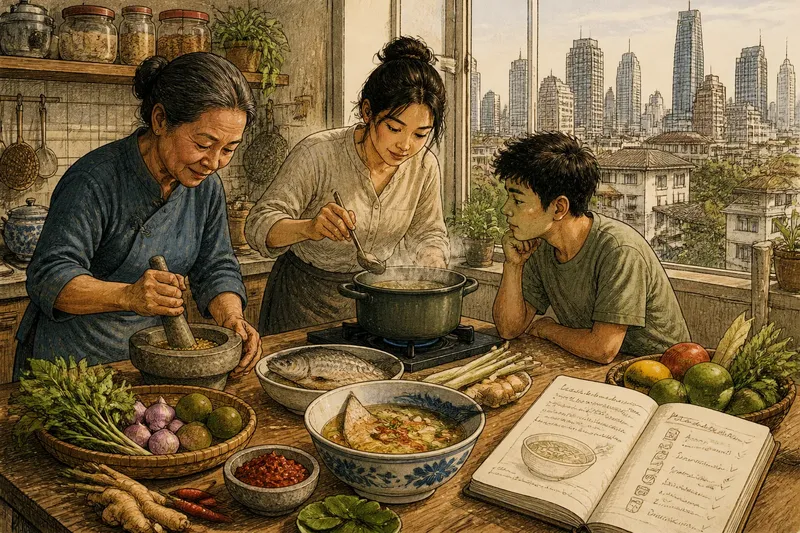
The most common mistake in adapting a family recipe in a new city is treating every ingredient and gesture as equally sacred. The cost is a dish that becomes difficult to make, or one that looks familiar on paper but has lost the flavor and meaning people hoped to keep. A useful approach is to identify what gives the dish its character, then make deliberate room for the new city around it.
That distinction matters for families moving within Asia as much as for those crossing continents. A cooking method may travel easily while a particular leaf, fish, flour, or cooking vessel does not. Even when the original ingredient is available, its freshness, cut, price, or role in the local market may differ. Adaptation is not a test of loyalty. It is a way to keep a dish usable and recognizable without pretending its surroundings have stayed the same.
How do you adapt a family recipe in a new city?
Start by writing down what the dish must still do for the people who care about it. That may be its aroma, the contrast of sour and rich flavors, a crisp edge, or the shared act of wrapping and serving it. Once those anchors are clear, change the details that depend on a particular market, kitchen, or household routine.
This is more reliable than preserving a list of ingredients without asking what each one contributes. A recipe copied from memory can make a particular product seem essential when its purpose is actually a texture, color, heat, or fragrance. The distinction lets a cook look for an equivalent without making a careless one-for-one swap.
Which parts of a dish are worth preserving?
Look for the qualities that make the dish recognizable to the people who know it. These can be sensory, practical, or social. A family may remember the toasted smell of spices, the soft filling inside a crisp wrapper, the degree of chili heat, or the fact that several people prepare the dish together.
To sort those elements, describe them in plain language before listing replacements:
- Flavor: Is the defining quality smoky, tart, deeply savory, herbal, or gently sweet?
- Texture: Does the dish need a yielding center, a brittle crust, a silky broth, or distinct grains?
- Method: Does its character depend on pounding, steaming, slow simmering, folding, or cooking over a flame?
- Balance: Which contrast matters most, such as hot and cooling, rich and acidic, or soft and crisp?
- Occasion: Is it a weekday meal, a holiday food, a welcome for guests, or something made jointly?
Not every answer needs to be protected. A certain serving bowl may be meaningful because it belonged to a relative, while the exact garnish may simply have been what was available. Separating emotional meaning from culinary function does not diminish either. It keeps a cherished object from being mistaken for a rule the food itself requires.
Which ingredients can change without changing the dish?
An ingredient can change when its job is understood and the replacement performs a similar job in the dish. A souring ingredient may supply brightness, a leafy herb may bring a fresh aroma, and a particular cut of meat may provide richness or structure. A substitute should be judged by that role, not merely by whether it shares a broad label such as “green,” “fish,” or “spice.”
Begin with the nearest local option, but consider its strength and texture. A fresh herb may be more pungent than the dried one in a remembered version. A local citrus may taste sharper or more floral than the fruit used at home. Additions are easier to adjust when introduced in modest amounts, especially when the replacement has a more assertive flavor.
Some ingredients do not swap neatly. A fermented paste, a specific grain, or a flour that shapes the dough may contribute several qualities at once. In those cases, keeping a small amount of the original ingredient, if practical, can work better than replacing it completely. Another option is to change the surrounding seasoning while leaving the ingredient that carries the dish’s most distinctive flavor intact.
Say a family has moved from a coastal town to an inland city and usually makes a sour fish soup with a local sea fish and a tart fruit that is hard to find. The cook could choose an available fish with a similarly firm texture, then use a locally sold souring ingredient while keeping the soup’s familiar balance of tartness, herbs, and gentle heat. The expected observable result is a soup with a different aroma at the edges but a recognizable texture and flavor structure. It would be a new version, not a claim that the two fruits taste identical.
What should stay the same in the cooking method?
Keep the method when it creates a quality that cannot be supplied by an ingredient swap. Browning, pounding, fermenting, steaming, and slow cooking each shape food differently. If a family’s version depends on a toasted spice base, for instance, changing the spices may be manageable; skipping the toasting may remove the aroma that holds the dish together.
At the same time, equipment and kitchen conditions can change the way a familiar method works. A narrow electric burner, a small apartment kitchen, a different pan, or limited ventilation may call for a change in batch size or cooking order. The aim is to preserve the useful effect of the method, not to imitate its old circumstances at any cost.
For a dish traditionally cooked in a heavy clay pot, a thick-bottomed metal pot may provide a practical alternative if the household is comfortable with the difference. The cook may need to watch for faster browning or a different rate of evaporation. The family’s memory can guide the result, but the pot does not need to become a test of authenticity. Follow the food as it cooks rather than relying on a copied timing note alone.
How can relatives agree on a new version?
Make the point of disagreement specific. “It tastes wrong” is a real reaction, but it does not say what should change. Ask whether the dish seems too sweet, lacks the old fragrance, has lost its chew, or no longer feels suited to the occasion. A concrete answer gives the cook something to adjust; a vague verdict tends to turn dinner into a family referendum.
When several relatives care about the recipe, record more than one memory of it. People may remember different versions because they learned at different ages, lived in different households, or prepared it for different occasions. A single “original” recipe may never have existed in the precise form a family now imagines.
It can help to keep a short note beside the recipe with the reason for each change: “use this leaf for its fresh aroma,” or “reduce the chili because the local variety is hotter.” That note preserves the decision, not just the substitution. If the household later finds the original ingredient, it can decide whether to return to it or keep the newer version.
What belongs in the recipe record?
Write down sensory cues as well as quantities. “Cook until the onions smell sweet and lose their sharp edge” may be more useful than an exact time, especially when burners and pans differ. Note the texture of a dough, the color of a toasted spice, or how the sauce should coat a spoon, while allowing for the fact that these cues will vary with ingredients and equipment.
Keep two kinds of detail distinct:
- Core cues: The flavors, textures, and method effects the family wants to recognize.
- Local notes: The market name of a substitute, a change in seasoning, or a kitchen adjustment that suits the current home.
This record can include alternate spellings or names used by local vendors. In a multilingual city, the same ingredient may be sold under several names, or a familiar name may refer to a different product. A description of appearance, aroma, and use can be more helpful than a translation alone.
Does changing a family recipe make it less authentic?
No single unchanged version is the only measure of authenticity. A dish belongs to the people who cook and share it, and recipes often shift as ingredients, kitchens, and household tastes shift. A version that preserves its defining qualities while adapting to local conditions can be honest about both its inheritance and its new setting.
That does not mean every change is equally successful. If the new version loses the balance or texture that relatives value, the family can adjust it again. Calling a dish “the city version” or noting who made a particular change is more precise than presenting one household’s choice as a rule for everyone.
Which adaptations are not worth the effort?
Do not spend a great deal of time chasing an ingredient whose contribution is minor when a local substitute already gives the dish its main character. Nor is it useful to recreate every old kitchen condition if doing so makes the recipe impractical to cook. A rare garnish that disappears into the finished dish may not deserve a long search; a spice that defines the aroma may.
Likewise, avoid adjusting several major elements at once if the aim is to understand what changed. Keeping the method and flavor balance steady while replacing one difficult ingredient makes the result easier to judge. This is not laboratory procedure. It is simply a way to avoid having no idea which change made dinner less familiar.
How should you describe the dish to the next generation?
Tell the story of both the old version and the current one. Explain what an ingredient used to contribute, what is used in its place, and why the family chose that change. A younger cook can then inherit a decision-making habit rather than a fixed list that becomes unusable as soon as the neighborhood market changes.
Keep the family recipe in a form someone can actually cook: a clear ingredient list, a few sensory cues, and notes about substitutions that have worked for the household. Where a label, manufacturer’s directions, or local rule affects ingredient handling, follow that guidance rather than guessing.
Adapting a family recipe in a new city is less about preserving an untouched artifact than keeping a relationship active. The dish can carry familiar flavor, technique, and company into a different kitchen while admitting what has changed. The most useful recipe is the one that tells the next cook what matters, what can move, and how to recognize the food when it reaches the table.